
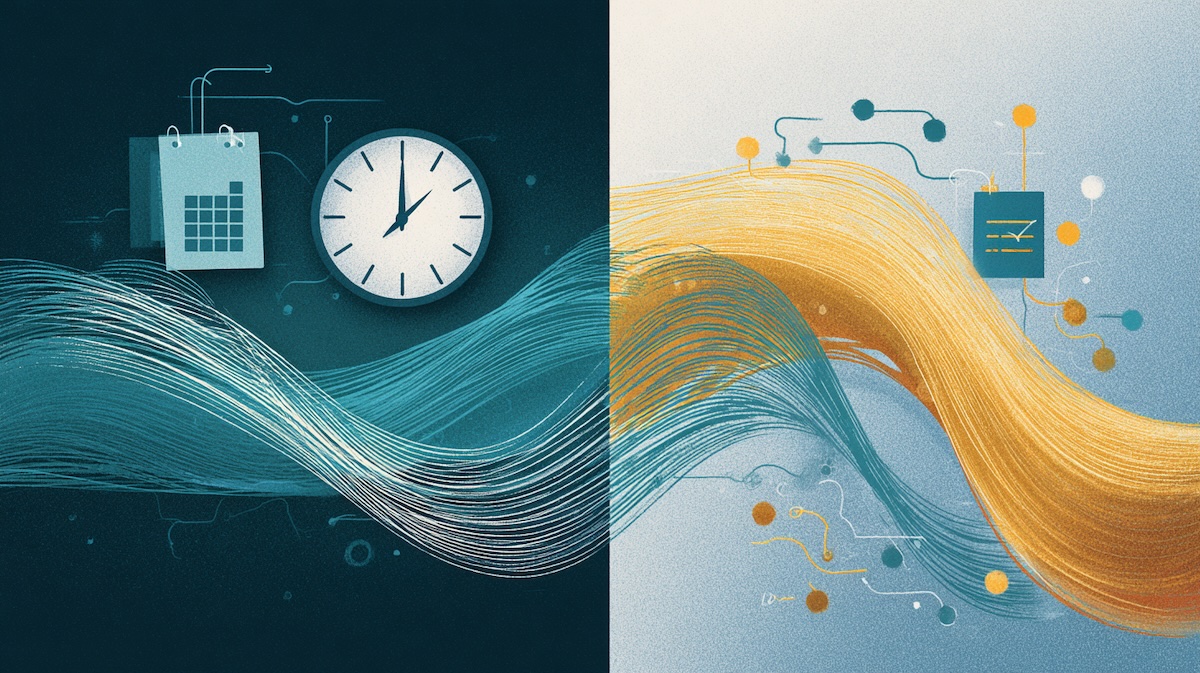
Most executives are still measuring AI through the lens of headcount and hourly cost. But agentic AI doesn’t work that way. The real metric isn’t time — it’s cost per outcome. Here’s what that shift actually looks like in practice.
Every business leader knows the formula. An employee costs $80,000 a year. That buys you roughly 2,080 hours. Efficiency means getting the most out of those hours. Need more output? Hire more people. Need it faster? Extend the hours. It’s the model we’ve built entire organisations around.
Then you deploy an AI agent, and the formula stops making sense.
An AI agent doesn’t have contracted hours. It doesn’t work 40 hours a week. It can run continuously, spin up multiple instances of itself, and scale from ten tasks to ten thousand in minutes. The constraints that define the economics of a human workforce – finite hours, sequential task execution, fixed capacity – don’t apply.
What does apply is a fundamentally different cost model: the cost of an AI agent is tied to the outcome it produces, not the time it takes to produce it.
The Same Technology, Different Economics
Consider two agents running side by side in the same organisation.
A customer service chatbot powered by an open-source language model handles thousands of enquiries daily at near-zero marginal cost. Each additional conversation costs fractions of a cent. Scale is effectively unlimited.
A video generation agent producing property marketing content runs through computationally intensive multimodal models. Each output might cost $5 to $15. Still dramatically cheaper than human production, but a completely different cost profile from the chatbot.
Same category of technology. Vastly different cost-per-outcome characteristics. This is why the old headcount-based budgeting model doesn’t translate — you’re not paying for time anymore, you’re paying for what gets produced.
What This Means for How You Lead
This shift has practical implications that go well beyond the technology team.
Budgeting changes. You need to model cost-per-outcome for your major workflows, not just plan headcount. What does each deliverable cost today in human time? What would it cost with an agent handling the repeatable components?
Measurement changes. AI agents need their own performance dashboards — cost per outcome, quality, throughput, error rates. These metrics will shift as models improve and pricing evolves. What costs $5 today might cost $0.50 in a year.
The real advantage is orchestration. A single chatbot automates a task. An orchestrated system of specialised agents, each handling a different part of a workflow alongside your human team, transforms a business capability. That’s where the compounding returns sit.
Augmentation, Not Elimination
At The Agency, where we support nearly 400 real estate agents and 900 staff with AI-powered systems, the strongest results come from human-AI configurations that are deliberately complementary. The AI handles volume, speed, and data processing. The human handles relationships, judgment, and the strategic advice that only comes from genuine experience.
When a buyer can get property data and market analytics from an AI in seconds, the human agent’s value isn’t in having the information — it’s in knowing what to do with it. The AI handles the data. The human handles the relationship. Together, they deliver something neither could achieve alone.
The Shift Is Already Underway
This isn’t theoretical. We’re seeing AI agents process hundreds of thousands of data events monthly, automate workflows that used to absorb significant team capacity, and enable our people to operate as strategic advisors rather than information processors.
The leaders who learn to think in outcomes rather than hours — who build the measurement systems and orchestration capabilities to manage this new model — will define how their industries operate for the next decade.
The question worth asking isn’t whether this transition is happening. It’s whether you’re building the infrastructure to lead it.